
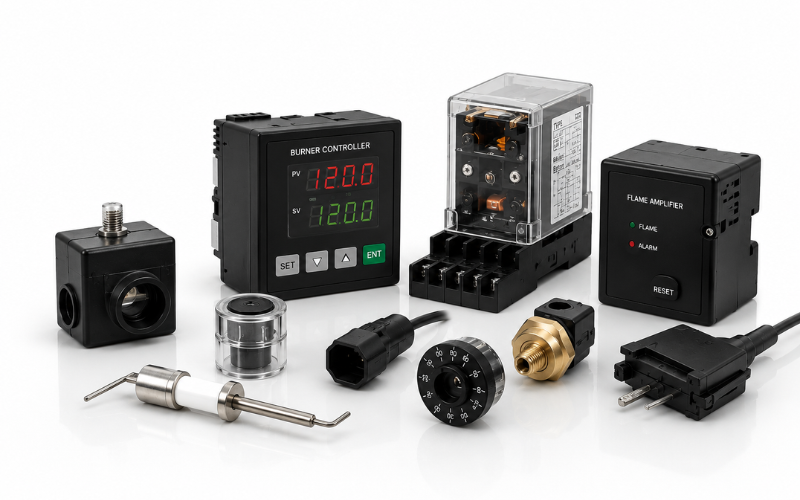
Reliable flame detection is an important part of industrial burner operation. Boilers, furnaces, thermic fluid heaters and process-heating systems need a dependable way to verify whether a flame is actually present during burner operation.
Two commonly used approaches are UV flame sensing and flame-rod sensing. Although both are used to monitor flame presence, they work through different detection principles and can suit different burner configurations.
For engineers, OEMs, maintenance teams and procurement professionals, understanding these differences can make it easier to identify an appropriate flame-monitoring arrangement.
Linear Systems manufactures both UV sensor and amplifier systems and flame-rod amplifiers, allowing different flame-detection configurations to be considered according to the application.
What Is Flame Detection in an Industrial Burner?
Flame detection is the process of identifying whether combustion is actually taking place inside a burner.
In an industrial combustion system, the burner controller may depend on a flame-detection signal before allowing the operating sequence to continue. If the expected flame signal is not available, the control system can respond according to the configured safety sequence.
A flame-monitoring arrangement generally consists of:
- A flame sensor or detection element
- An amplifier or signal-processing unit where required
- A burner controller or sequence controller
- Associated safety/interlock circuitry
The exact configuration depends on the burner design, fuel, combustion chamber and control architecture.
How Does a UV Flame Sensor Work?
A UV flame sensor detects ultraviolet radiation associated with a flame.
Linear Systems describes its UV Flame Sensor as using a sensitive electronic UV tube designed to detect ultraviolet radiation from naked flames. The company also states that the sensor is designed to be insensitive to visible light and refractory glow, supporting flame verification in industrial environments.
The basic operating arrangement can be understood as:
Flame → UV radiation → UV sensor → amplifier → burner control system
The UV sensor identifies the relevant radiation, while the amplifier processes the signal and can provide the required output to the control or safety circuit.
Linear Systems lists UV flame-monitoring applications across industrial boilers, gas- and oil-fired burners, furnaces, kilns, thermic fluid heaters and process-heating systems.
Why UV Detection Can Be Useful
UV flame detection can be useful where the application requires dedicated flame sensing based on the ultraviolet characteristics of combustion.
Important considerations include:
- Flame characteristics
- Burner geometry
- Sensor mounting position
- Sight path to the flame
- Ambient conditions
- Required response characteristics
- Compatibility with the control system
The sensor should always be selected according to the actual burner configuration rather than simply by choosing a technology based on the product name.
How Does a Flame Rod Sensor Work?
Flame-rod sensing uses the electrical properties of a flame to verify flame presence.
A flame rod is positioned within the combustion zone. When the flame is established, ionised particles within the flame allow a small electrical current to flow between the electrode and ground.
The amplifier detects this current and provides a corresponding flame-presence signal to the burner controller.
Linear Systems describes its flame-rod amplifier as operating using the flame detection rectification technique. The company explains that the amplifier works with a flame-rod sensor and detects the microamp-level current associated with flame presence.
The simplified sequence is:
Flame rod → flame rectification signal → amplifier → burner controller
This makes the flame rod and amplifier a combined detection arrangement rather than treating the electrode as an independent control device.
UV Flame Sensor vs Flame Rod: Key Differences
The biggest difference is the physical phenomenon being detected.
| Factor | UV Flame Sensor | Flame Rod |
|---|---|---|
| Detection principle | Ultraviolet radiation | Flame rectification |
| Main sensing element | UV tube/sensor | Flame electrode/rod |
| Typical integration | UV sensor + amplifier + controller | Flame rod + amplifier + controller |
| Installation consideration | Requires suitable flame viewing path | Electrode must be correctly positioned in flame |
| Common application relevance | Industrial burners, boilers and furnaces | Particularly relevant to suitable gas-fired burner configurations |
| Selection priority | Flame visibility, mounting and system compatibility | Electrode placement, burner configuration and electrical characteristics |
These are not simply interchangeable components. The appropriate method depends on the burner design and control system.
When Should You Consider a UV Flame Sensor?
UV flame sensing may be considered when the burner and combustion chamber are suitable for optical flame detection.
For example, Linear Systems lists UV sensing applications for:
- Industrial boilers
- Steam generators
- Oil- and gas-fired burners
- Furnaces
- Kilns
- Thermic fluid heaters
- Petrochemical and process-heating systems
- Dairy and food-processing plants
For OEMs and plant engineers, the important point is to assess the complete burner assembly rather than selecting the sensor in isolation.
When Should You Consider a Flame Rod?
Flame-rod detection can be appropriate when the burner design supports electrode-based flame rectification.
The flame rod needs to be positioned appropriately within the combustion zone and connected to a compatible flame-rod amplifier and burner-control system.
Linear Systems lists flame-rod amplifiers for applications including:
- Gas-fired burners
- Oil-fired burners
- Industrial furnaces and ovens
- Boilers and steam generators
- Thermic fluid heaters
- Process-heating systems
Factors to Consider Before Selecting a Flame Detection System
1. Burner Fuel
The fuel being used can influence the suitable flame-detection approach. Gas, oil and other combustion arrangements can have different flame characteristics.
2. Burner and Combustion-Chamber Design
The physical construction of the burner and furnace affects sensor installation, flame visibility and electrode positioning.
3. Existing Burner Controller
The flame sensor or amplifier should be compatible with the existing burner controller and safety sequence.
4. Installation Conditions
Consider the operating environment, temperature, mounting arrangement, access for maintenance and potential contamination.
5. Required Signal Processing
Some systems require a separate amplifier between the sensor and burner controller. Linear Systems provides both UV flame amplifiers and flame-rod amplifier solutions.
6. OEM or Replacement Requirements
For replacement projects, the existing controller, sensor arrangement and wiring configuration should be reviewed before selecting a replacement component.
Why the Flame Amplifier Matters
The amplifier acts as an important interface between the flame-detection element and the burner-control system.
For UV systems, the amplifier processes the sensor signal and can operate the relevant safety relay or alarm circuit. Linear Systems lists UV amplifier configurations with relay outputs and an adjustable time-delay model for applications involving flicker or unstable flame conditions.
For flame-rod systems, the amplifier detects the small electrical signal generated through flame rectification and communicates flame presence to the controller.
Therefore, choosing a flame sensor should also involve checking the compatibility of the associated amplifier and controller.
Common Industrial Applications
Flame detection systems are used across many process-heating environments, including:
- Industrial boilers
- Steam generation systems
- Gas-fired burners
- Oil-fired burners
- Furnaces and ovens
- Kilns
- Thermic fluid heaters
- Petrochemical plants
- Chemical processing
- Food and dairy processing
- Other process-heating installations
The appropriate flame-detection technology should be evaluated against the actual application and burner configuration.
Frequently Asked Questions
Is a UV flame sensor better than a flame rod?
Neither technology should be treated as universally better. The appropriate choice depends on the burner configuration, flame characteristics, installation conditions and compatibility with the burner-control system.
What is the difference between a UV sensor and a flame rod?
A UV sensor detects ultraviolet radiation associated with the flame, while a flame rod uses flame rectification to detect the electrical conductivity of the flame.
Does a flame rod need an amplifier?
In an industrial control arrangement, a compatible flame-rod amplifier may be used to detect and process the small electrical signal generated by flame rectification. Linear Systems offers flame-rod amplifier solutions for this purpose.
Where are UV flame sensors used?
Linear Systems lists applications including industrial boilers, burners, furnaces, kilns, thermic fluid heaters and process-heating systems.
Can flame sensors be used with existing burner controllers?
Compatibility needs to be checked based on the controller, sensor, amplifier and electrical configuration. Replacement should not be selected only from physical appearance or application name.
Conclusion
UV flame sensors and flame rods provide different approaches to flame monitoring. UV sensing relies on ultraviolet radiation from the flame, while flame-rod systems use flame rectification to confirm flame presence.
For an industrial burner, the selection should consider the burner design, fuel, installation environment, controller compatibility and maintenance requirements.
Linear Systems provides UV sensors and amplifiers, flame-rod amplifiers, flame sensors, flame switches and burner sequence controllers, enabling OEMs and industrial users to evaluate integrated flame-monitoring solutions.