
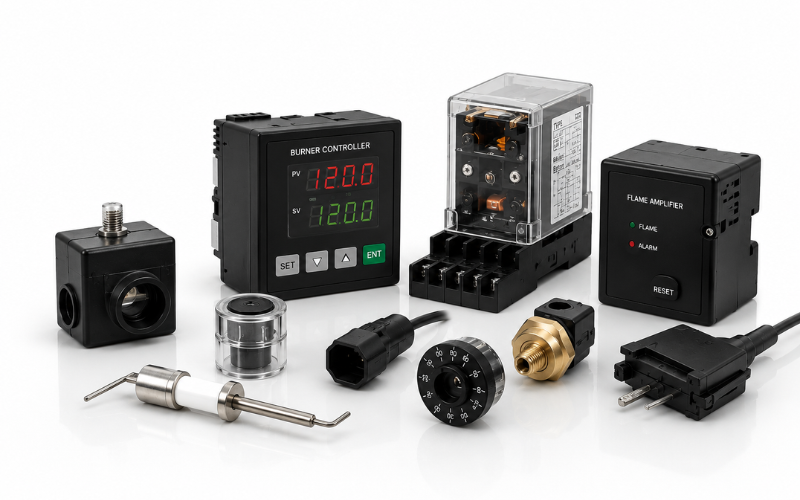
Industrial burners depend on coordinated control of ignition, flame verification and operating sequences. In a boiler or furnace, the burner controller is therefore more than a simple switching device. It forms part of the control arrangement that coordinates different stages of burner operation.
For OEMs, plant engineers, maintenance teams and procurement professionals, selecting a burner sequence controller requires consideration of the burner type, fuel, flame-sensing method, ignition arrangement and existing control architecture.
Linear Systems manufactures burner sequence controllers for industrial burners and lists configurations for both oil-fired and gas-fired applications.
What Is a Burner Sequence Controller?
A burner sequence controller manages predetermined stages in burner operation.
Depending on the system configuration, these stages can involve functions associated with:
- Burner start-up
- Pre-purge
- Ignition
- Pilot or main-flame proving
- Flame monitoring
- Burner operation
- Safety response
- Shutdown
The exact sequence depends on the burner and controller design.
Linear Systems describes its burner sequence controllers as being designed to work with critical components including flame sensors, ignition transformers and flame switches.
This means that the controller should be evaluated as part of the overall combustion-control system rather than as an isolated component.
Why Is Burner Sequence Control Important?
A burner has to follow a defined operating sequence rather than simply switching fuel and ignition on at the same time.
The control sequence needs to coordinate the various components involved in starting and maintaining combustion.
For an industrial boiler or furnace, the control system may need to account for:
- Air and purge conditions
- Ignition
- Flame establishment
- Flame verification
- Fuel control
- Burner shutdown
- Safety interlocks
A suitable sequence controller helps coordinate these functions according to the design of the burner.
Key Factors When Choosing a Burner Sequence Controller
1. Identify the Burner Type
The first consideration is the type of burner for which the controller will be used.
Oil-fired burners and gas-fired burners can require different control arrangements.
Linear Systems lists dedicated sequence-controller configurations for oil-fired burners/boilers as well as gas-fired burners and furnaces.
Before selecting a controller, identify:
- Fuel type
- Burner configuration
- Burner capacity/application
- Pilot arrangement
- Existing ignition system
- Existing flame-sensing technology
2. Understand the Flame-Sensing Method
Flame verification is a critical part of burner control.
Depending on the burner, flame detection may use:
- UV flame sensing
- Flame-rod sensing
- Photocell-based detection
- Other compatible flame-monitoring arrangements
Linear Systems offers burner sequence controllers designed for UV and flame-rod sensing configurations.
The controller therefore needs to be compatible with the selected flame-detection method.
3. Check the Ignition Arrangement
Ignition is another important part of the burner sequence.
The sequence controller may interact with the ignition transformer and associated ignition circuit.
Linear Systems manufactures ignition transformers designed for industrial boilers, oil- and gas-fired burners, furnaces, kilns, thermic fluid heaters and process-heating systems.
When replacing an existing controller, the ignition arrangement should therefore be reviewed alongside the controller rather than considered separately.
4. Consider Pre-Purge Requirements
Pre-purge is an important stage in many burner operating sequences.
The required purge duration can vary according to the burner and application.
Linear Systems lists burner sequence-controller models with different pre-purge configurations, including the 107-S-60 and 107-S-30 models for oil-fired applications.
This demonstrates why the controller should be selected according to the actual burner sequence rather than simply based on the controller’s general category.
5. Determine Whether Pilot Flame Proving Is Required
Gas-fired burners may use different arrangements depending on whether pilot flame proving is incorporated.
Linear Systems lists gas burner controllers with and without pilot flame proving, including configurations incorporating UV amplification and terminals for damper, blower and ignition functions.
When specifying a controller, establish whether the burner uses:
- Pilot flame
- Direct ignition
- UV flame sensing
- Flame-rod sensing
- Damper control
- Blower control
These details can significantly influence controller selection.
6. Check Existing Equipment Compatibility
For replacement projects, compatibility is one of the most important considerations.
Before purchasing a replacement burner sequence controller, collect information about the existing system, such as:
- Existing controller model
- Burner manufacturer
- Burner type
- Fuel type
- Flame sensor
- Flame amplifier
- Ignition transformer
- Existing wiring arrangement
- Required sequence
- Available supply voltage
- Connected safety devices
A controller that appears similar externally may still have different operating characteristics or connection requirements.
7. Consider Flame Amplifier Compatibility
The flame amplifier processes the signal received from the flame-detection device.
For example, Linear Systems’ flame-rod amplifier uses flame rectification to identify flame presence and provide the relevant signal to the burner controller.
Similarly, the company’s UV flame amplifier systems process signals from UV sensors and provide outputs for applications such as alarm, trip or annunciation circuits.
Therefore, the sequence controller, amplifier and sensor should be considered as a connected system.
8. Look at Installation and Maintenance Requirements
Industrial equipment needs to be practical for plant personnel to operate and maintain.
Useful considerations include:
- Accessibility
- Status indication
- Reset arrangements
- Enclosure design
- Wiring access
- Replacement procedure
- Availability of technical support
- Spare availability
Linear Systems states that its products include features such as LED indication of sequence progress, local and remote reset facilities and compact enclosures.
These types of features can be useful considerations when comparing controller configurations for an industrial installation.
Burner Sequence Controllers for Oil-Fired Applications
Oil-fired burners can require dedicated sequence arrangements for ignition, flame monitoring and burner operation.
Linear Systems lists multiple sequence-controller models for oil-fired burners and boilers, including configurations identified for furnace-oil systems and specific boiler applications.
For an oil-fired burner project, the selection process should begin with the actual burner and boiler configuration.
Important information to provide the supplier includes:
- Burner make and model
- Fuel type
- Existing controller
- Flame-sensing method
- Ignition arrangement
- Required purge sequence
- Existing wiring information
Burner Sequence Controllers for Gas-Fired Applications
Gas-fired burners can use UV or flame-rod sensing depending on the burner configuration.
Linear Systems lists controller configurations for gas-fired burners and furnaces with UV sensing, as well as controllers designed for flame-rod sensing.
For example, the website lists:
- Controllers with inbuilt UV amplification
- Controllers with external UV amplification
- Gas controllers with pilot-flame arrangements
- Controllers for flame-rod sensing
This illustrates why “gas burner controller” alone may not provide enough information to identify the correct configuration.
Burner Sequence Controller vs Burner Controller
The terms can sometimes be used interchangeably in industry, but the exact functionality depends on the equipment design.
A burner sequence controller generally focuses on coordinating a defined sequence of burner operations and associated safety checks.
A broader burner-control system can include additional components such as:
- Sequence controller
- Flame sensor
- Flame amplifier
- Ignition transformer
- Flame switch
- Burner valves
- Blower/damper controls
- Safety interlocks
Linear Systems’ product range covers several of these components, allowing the control arrangement to be considered as an integrated system.
Common Applications
Burner sequence controllers can be relevant to a wide range of industrial heating equipment, including:
Industrial Boilers
Controllers coordinate burner startup and flame-monitoring functions in boiler applications.
Furnaces and Ovens
Industrial furnaces may require controlled ignition and flame monitoring throughout their operating sequence.
Process Heating Systems
Manufacturing processes often rely on stable and controlled heat generation.
Thermic Fluid Heaters
Burner control is an important component of combustion-based heating systems.
Oil- and Gas-Fired Burners
The appropriate controller configuration depends on fuel type, burner design and flame-detection method.
A Practical Burner Controller Selection Checklist
Before requesting a quotation, plant engineers or procurement teams can prepare the following information:
Burner Information
- Burner make and model
- Fuel type
- Application
- Burner capacity
Control Information
- Existing controller model
- Required operating sequence
- Pre-purge requirement
- Pilot arrangement
- Reset arrangement
Flame-Monitoring Information
- UV sensor
- Flame rod
- Photocell
- Flame amplifier
- Existing flame switch
Ignition Information
- Ignition transformer
- Ignition terminals
- Existing ignition sequence
Providing these details can help the manufacturer determine a suitable configuration and reduce compatibility issues during replacement or retrofit projects.
Frequently Asked Questions
What does a burner sequence controller do?
A burner sequence controller coordinates the defined operating stages of a burner, including functions associated with ignition, flame verification and burner operation, depending on the system configuration.
How do I select a burner sequence controller?
Start with the burner type, fuel, existing controller, flame-sensing method, ignition arrangement and required sequence. Compatibility with associated components should also be checked.
Can one burner controller work with both gas and oil burners?
Controller suitability depends on the specific configuration. Linear Systems lists separate configurations for oil-fired and gas-fired applications, so the burner and sequence requirements should be evaluated before selection.
What components work with a burner sequence controller?
Depending on the application, a burner sequence controller can work as part of a system incorporating flame sensors, flame amplifiers, ignition transformers, flame switches and other burner-control components.
Why is flame-sensor compatibility important?
The controller needs to receive and interpret the appropriate flame-presence signal. Different flame-monitoring technologies, such as UV sensing and flame-rod detection, use different detection principles and associated amplification arrangements.
Can a burner sequence controller be used for replacement projects?
Yes, but replacement should be based on the actual burner sequence, existing components and electrical/control requirements rather than simply matching the physical dimensions of the old controller.
Conclusion
Choosing a burner sequence controller requires more than identifying the burner fuel or application. The controller should be evaluated as part of the complete combustion-control arrangement.
Fuel type, burner configuration, flame-sensing method, pre-purge requirements, ignition arrangement, pilot configuration and compatibility with existing equipment are all important considerations.
Linear Systems offers burner sequence controllers for oil-fired and gas-fired burner applications, along with associated UV flame sensors and amplifiers, flame-rod amplifiers, ignition transformers and other burner-control components.